
How to ask students for useful feedback


“Everything is fine” may be pleasant to hear, but it gives a teacher little to work with. This guide looks at a familiar difficulty: asking students for feedback that actually helps you understand their experience.
Here we cover why to ask, when to make room for the conversation and which formats to try.
What thoughtful feedback looks like
Students do not always stop to analyse how they are learning. A broad “Do you like the lessons?” can therefore produce a polite “I like everything”. That tells you little about what to keep or change.
More specific questions give the learner something concrete to reflect on. Their answers can help you understand your audience, adjust the programme and address difficulties before motivation drops.
Ask for feedback to understand how the student is doing. That includes how they feel, as well as whether they understood the material. Online lessons often call for a great deal of independence and motivation.
Liza Pachina, English teacher
What to ask about
1. Topics and materials
You can ask after each lesson or at the end of a unit, module or topic. Try questions such as:
- “Was anything unclear?”
- “What did you find difficult?”
- “What did you have enough time for? What needed more time?”
- “What would you like to see in the next materials?”
You can also focus on the work just completed. Try wrap-up or cool-down prompts for the student to complete:
- This lesson felt … (difficult, easy, useful, and so on).
- I found … difficult (the grammar, the video, the vocabulary).
- After this lesson, I can … (for example, name the items in a kitchen or answer job-interview questions). Give the student space to say what they have gained.
- The words I found hard to pronounce were …
- After the lesson, I feel … (inspired, happy, sad, discouraged). Let the student think about their response to the lesson, rather than choosing a “correct” emotion.
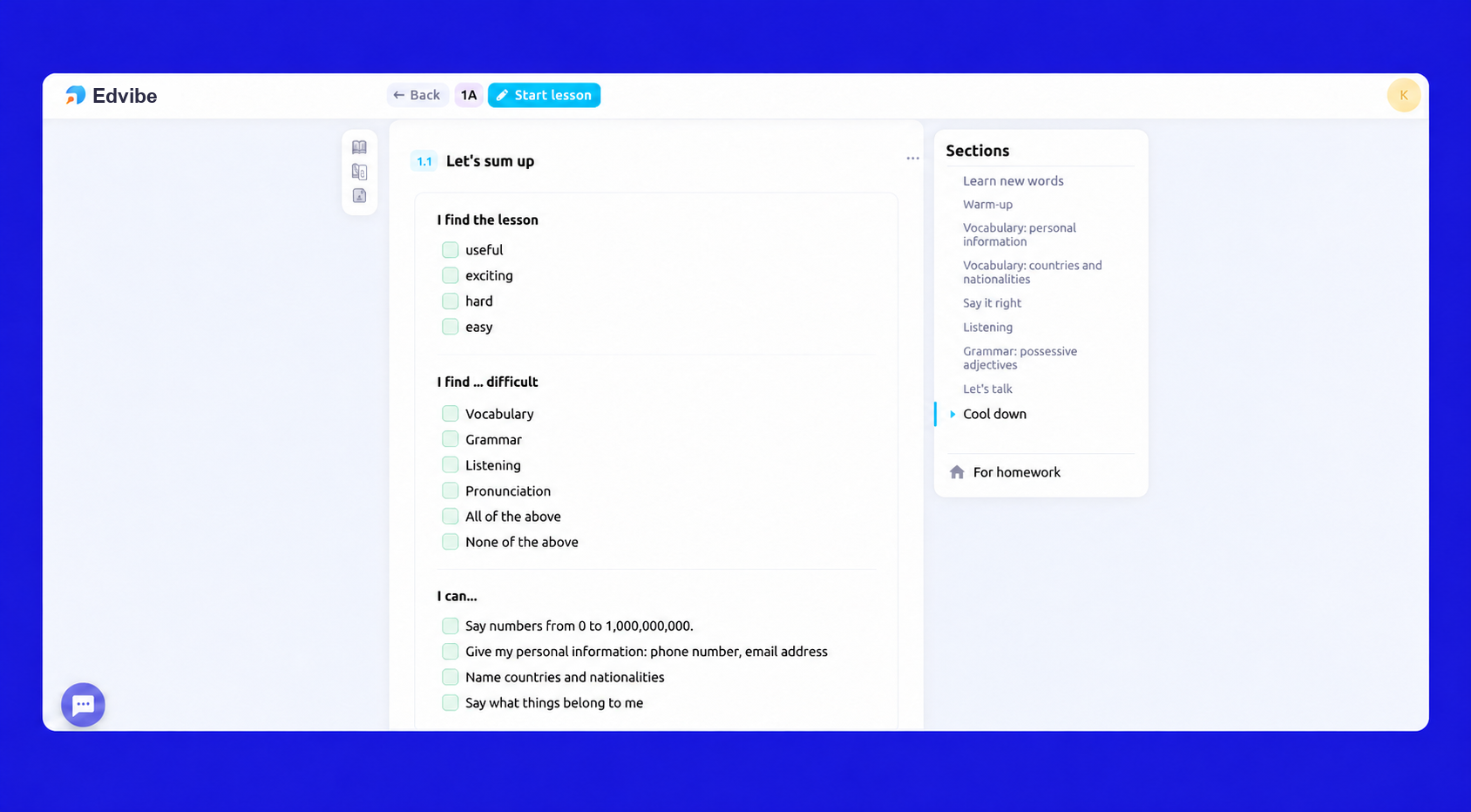
These answers can help you notice difficulties, decide what to revisit and understand how a student feels after class.
2. The learning experience
Choose an interval that suits your work, for example every six months, for a longer conversation. Ask how lessons feel, whether the student notices progress, what affects motivation and whether their plans have changed. A learner may start thinking “I'm not getting anywhere, so I don't want to continue”. Or the original reason for studying, such as travel or an exam, may no longer apply. Discuss a new direction if needed, and share concrete feedback on the progress you have seen.
If you teach children or teenagers, ask parents for feedback too. A child may say one thing in class and something different at home. Keeping in touch with parents gives you another perspective and a way to respond to concerns.
At the end of the month, I send parents a report on what we have done and their child's results. I also answer questions and collect suggestions. Sometimes we have long calls. Every six months, I try to set aside enough time to discuss everything properly.
Liza Pachina, English teacher
3. The teacher's work
Language schools can also ask students about the teacher, particularly in group classes. Use the answers to identify concerns and discuss teaching quality. Collecting feedback only helps a school's reputation if the school listens and responds to what it learns.
Ways to collect feedback
1. A conversation
Independent teachers often use direct conversation. It gives you room to build trust, ask follow-up questions and understand motivation. Set aside more time when you need to review the student's experience in detail.
2. A survey
Google Forms lets you create a survey. A short form can suit frequent feedback, such as after each lesson, without taking much class time. You can reuse a questionnaire with multiple-choice questions or rating scales about clarity, difficulty or the student's experience.
Open questions offer a written alternative to a conversation. Some learners may find it easier to pause, think and explain their experience in writing. Choose the format with the student, rather than assuming everyone prefers speaking.
On Edvibe, you can include feedback questions in the lesson itself, using a writing activity or a question with answer options. Ask students to explain a rating rather than treating the number alone as a measure of learning.
3. A game or visual activity
Pictures can make feedback more accessible for children or groups. Show emotion stickers, such as sad, happy, sleepy or inspired, and ask learners to choose one that matches how they feel about the lesson. Invite them to explain their choice.
For a group, try an interview activity. Give students a question list and put them in pairs. The interviewer writes down the answers and shares them with you. Alongside collecting feedback from each learner, the activity gives students English practice and a chance to reflect through discussion with someone else.
You may need to agree a few ground rules: be honest, be polite, feel free to criticise and, where possible, suggest an improvement. Make clear that students do not have to praise the lesson to please you.
A short feedback routine can give you something useful to act on. Ask about a specific part of the lesson, listen to the answer and decide what to change or discuss next.


