
How to Create a Quest-Based Lesson

A quest-based lesson can offer a change from working through coursebook units while still keeping to your learning plan.
In this article, teaching methodologist Anastasia Lagutkina explains how classroom quests work and what to consider when you design one. The Christmas themes at the end offer starting points for your own quest.
What is a quest-based lesson?
A quest-based lesson uses gamification: game mechanics and an additional goal or reward encourage learners to take part. The learning task remains, but students have another reason to complete it. Even a gap-fill activity can become part of a challenge with a clear purpose.
The approach described here has four main components:
- Mechanics: points, progress indicators, rankings and levels of difficulty.
- Scoring: the rule for awarding points, such as a point for each correct task or completed section.
- Behaviour: how the game changes the way students take part and interact with their teacher and classmates.
- A reward: something participants work towards and can use to recognise their achievement afterwards.
How to use rewards
Possible rewards or progress markers for a classroom quest:
- Points or scores
- Badges or stickers
- Special items or elements collected after completing tasks
- A leaderboard
- A chart showing participants' progress
You can award them for:
- Completing a task within a time limit
- Completing a task correctly
- Finishing before another participant
- Another achievement that fits your quest's theme
Where gamification can fall short
Not everyone wants to play
Students differ. Points, stickers and badges will not appeal to everyone. A classroom quest also cannot replace the experience of playing a game such as Minecraft or Fortnite.
Are we playing or learning?
The quest format can leave some students unsure what they are supposed to be learning. Teachers need to keep the learning purpose visible while making room for the game.
The learning still needs to matter
A generic activity with game mechanics may not feel personal. Vocabulary flashcards, for example, can look like a game, but the words still need to be relevant to the learner.
A short-term boost is not a lasting habit
Gamification may help a student engage in the moment. It does not, by itself, establish a long-term vocabulary or grammar practice habit.
Ways to make classroom quests more varied
A points system and a reward give you a starting structure. The activities inside it still need to hold the students' interest. Here are some ways to vary what learners actually do.
Add movement. Take a familiar topic such as hobbies. Instead of simply asking students about it, ask them to photograph something connected to their hobby: medals, a craft project or another object they can show. Upload the pictures to the class whiteboard and discuss them. In a group, have students ask one another questions. The photographs give everyone something specific and personal to talk about.
Use pair or group tasks. When learners talk to one another, they have more speaking time and the teacher can step back. For example, the tic-tac-toe activity in the quest lesson can be played in pairs. Give clear instructions so students know what to say and how a turn works.
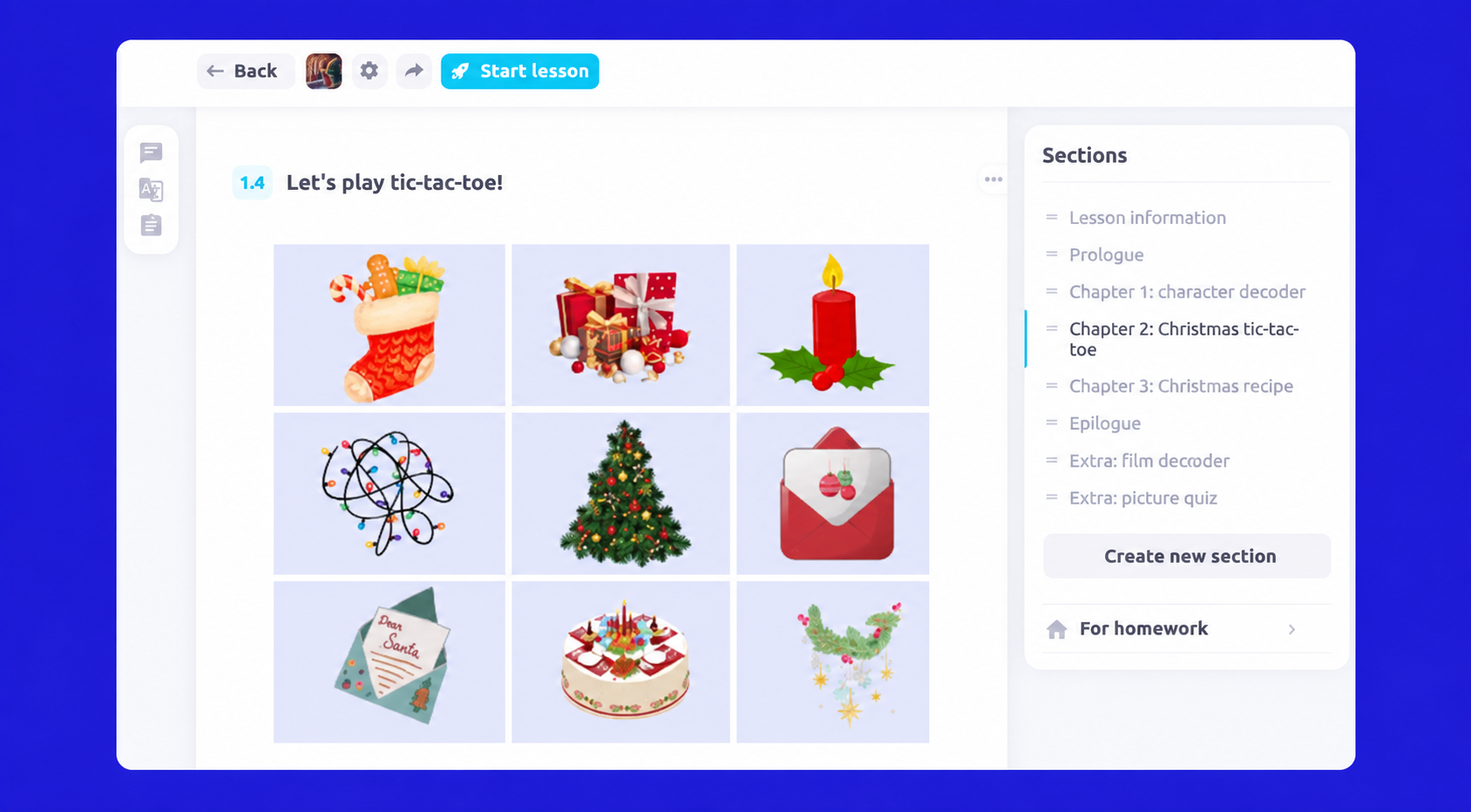
Give the quest a visual identity. Pictures, memes and illustrations related to the text can help students follow the story and notice important details.
Keep the learning load manageable. Avoid filling a quest with too much new material. Give learners enough familiar language to take part, and choose the vocabulary or grammar you want them to practise.
Include an occasional surprise. The entire lesson does not have to depend on entertainment. An unexpected appearance by a favourite character, for example, can be one small part of the activity.
Christmas quest ideas
For A2 learners, a theme such as Christmas and All That Jazz can bring festive vocabulary into a sequence of clues. At B1, a question such as Did Charles Dickens Reinvent Christmas? can frame a reading-and-discussion quest. Prepare the clues, texts and tasks around the language your students already know and need to practise.
Build the activities with Edvibe’s exercise templates or whiteboard. Explore Edvibe lesson tools.
For more ideas on varying a lesson, see these teaching suggestions.


