
Spaced Repetition for Vocabulary: A Practical Guide for Teachers

A student recognises a word in an exercise but cannot find it during a conversation. You review it together, then encounter the same problem a week later. Spaced repetition helps you plan those returns instead of treating vocabulary as finished after one lesson.
The idea is to revisit material after a gap and use the learner's response to decide when to review it again.
Repetition and the forgetting curve
Hermann Ebbinghaus studied forgetting using material such as unfamiliar syllables. His work is commonly illustrated with a curve showing retention falling over time.
A curve can explain why reviewing matters, but it cannot predict exactly how much a particular student will remember after an hour or six days. The material, prior knowledge and learning conditions all matter.
When you return to vocabulary, check what the student can do: recognise its meaning, retrieve it without a prompt or use it appropriately. Those are different tasks.
The illustration below is a schematic explanation of forgetting and review. Its percentages and intervals are not a universal schedule for every learner.
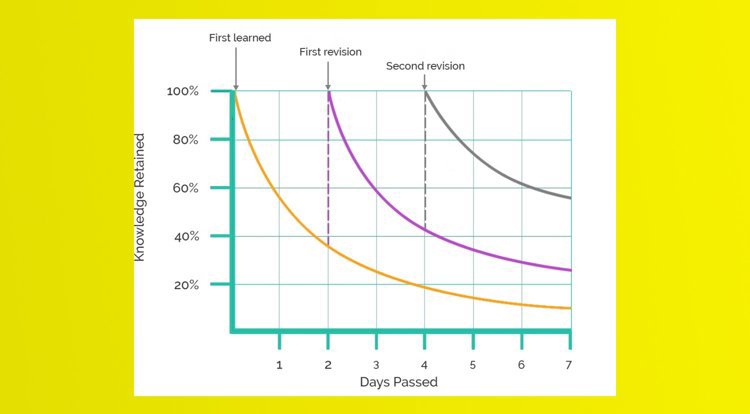
Returning to material across separate occasions gives learners further opportunities to retrieve it. The quality of those attempts also matters: recognising a familiar card is different from finding the expression during a conversation.
Approaches to spaced repetition
Spaced practice appears in different forms, from audio language courses to paper cards and software that schedules reviews.
The Pimsleur approach
Pimsleur language courses revisit expressions within spoken exchanges. Learners hear a prompt, try to respond and hear the model again later.
For a teacher, the useful planning idea is to bring an expression back during a lesson and on later occasions. A published sequence of intervals should not be treated as the only correct timetable for every word or learner.
The Leitner card system
A Leitner-style system sorts cards into groups that are reviewed at different intervals. For example, use three boxes:
- New or difficult words, reviewed sooner
- Words the learner can retrieve with some effort, reviewed after a longer gap
- More secure words, revisited less often and in new contexts
Show the prompt before revealing the answer. After a successful response, move the card to a group with a longer interval. If the student cannot retrieve it, move it back to a group they review sooner.
You could start with daily review for the first group and a few days between later reviews, then adjust the routine. These are example settings, not a validated schedule for every student.
Flashcards and vocabulary apps
Tools such as SuperMemo and Anki use scheduling systems to organise review. Other vocabulary tools offer different combinations of cards, quizzes and practice. Check the actual functions before choosing one for a student.
Decide what the learner needs to do: hear pronunciation, type an answer, recall a phrase or review on a phone. Also check how much time maintaining the cards will take.
Keep vocabulary connected with the student's work. Words from a lesson, text or conversation give them a context to return to. If they learned reschedule while discussing meetings, retain an example such as “Could we reschedule the meeting?”
The illustration below shows how selecting a word within lesson material keeps it connected with its context. Edvibe has a personal dictionary; use it alongside the review schedule you plan for your student rather than assuming it implements a particular spaced-repetition algorithm.
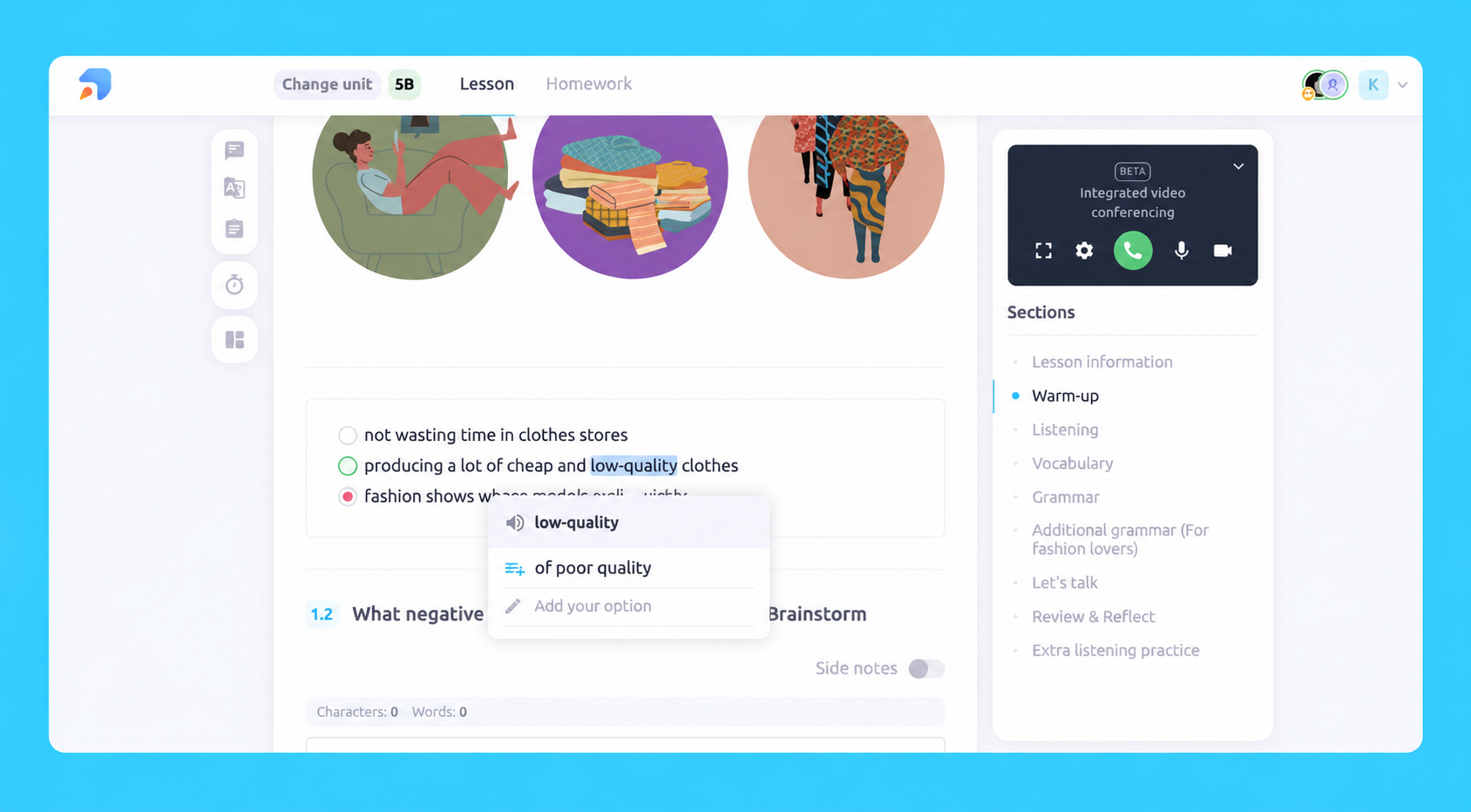
Bring those words back in later tasks. For reschedule, ask the student to change a meeting time, explain a conflict or write a short message. Later, use a different situation so they have to choose how to use the expression again.
How often should students review a word?
There is no single number of repetitions that guarantees a word will become usable vocabulary. Recognition, recall and use in speech need different checks.
Vary the activity: a picture description, short dialogue, question, sentence completion or listening task can bring the same expression back with a new purpose.
If the student repeatedly misses a card, inspect the prompt. It may be unclear or allow several answers. If the review queue becomes too large to maintain, reduce it and keep the vocabulary relevant.
At the next lesson, ask for a short use of a few target expressions. Let the response guide the next review. If you are choosing a place for lesson materials and vocabulary work, explore Edvibe.


