
When to Stop Teaching a Student: Teachers Share Their Experiences


Why do teachers sometimes decide to stop working with a learner?
When you first start teaching, you may accept almost everyone because you need experience and income. With time, you may have more room to choose the work you take on, including recognising when a teaching relationship is no longer working.
Situations teachers described
1. You are not a good fit
Being comfortable working together matters, particularly when learning is difficult. If you find yourself persistently irritated by a learner, or they seem uncomfortable with you, it is worth discussing whether another teacher or format would suit them better.
2. The learner often misses lessons
Repeated absences can make progress difficult. For adults, the issue may be competing priorities or the practicalities of organising study. With children, the parent’s wish for language lessons may not be shared by the child. Find out what is happening before deciding how to proceed.
3. Expectations are unrealistic
A parent may expect a tutor to supervise everything, improve school results within a week or resolve difficulties beyond the teacher’s role.
Sometimes those expectations only emerge after lessons have begun. Explain what you can reasonably do and what you cannot promise. If you cannot reach an agreement, continuing may not help either side.
An adult’s expectation of learning English in three months may come from a misunderstanding of their starting point or from advertising. Discuss the target and the work involved. If your expectations remain incompatible, it may be time to reconsider the arrangement.
4. The agreed independent work is not happening
A teacher may plan lessons around work the learner has agreed to do between sessions. If it repeatedly goes unfinished, while the learner is unhappy about progress, the two of you need to revisit that agreement.
Senior Materials Writer Anastasia Lagutkina describes ending lessons in this situation:
We had planned the work needed to reach the learner’s goal. I always put together a course programme, but he regularly did not do the tasks. Then, in the lesson, he would ask why a particular aspect of the language still needed more attention. Usually it was precisely something that needed practice at home as well.

I explained directly why I was stopping the lessons. It was straightforward because I keep a record of completed homework. There was no negative reaction. Instead, we established that English was not such a high priority for him after all.
Anastasia recommends explaining how you reached the decision rather than leaving the learner guessing.
They may even feel relieved that you have said something they were afraid to admit to themselves.
5. The learner constantly challenges how you teach
There is a difference between a learner asking for different materials or a change in lesson structure and repeatedly questioning everything the teacher says or dictating each step.
Discuss what each of you needs from the lessons. If you cannot establish a workable relationship, continuing in a hostile atmosphere may not be useful.
6. The learner feels the lessons cost too much
Teacher Irina Kuznetsova, in her article about difficult teaching relationships, links repeated objections to price with other problems she has encountered, including late cancellations and disappearing after a holiday. That is her experience, rather than evidence that asking about a price makes someone a problematic client.
English teacher and Engsider founder Elizaveta Pachina prefers to establish fit before starting:
I only accept learners after an interview, so people who are not a good fit for me tend to be filtered out at that stage.
7. The learner wants lessons without independent work
If your programme requires practice outside lessons and the learner does not want that, be clear about the mismatch. Discuss whether a different format or a different goal would work before making promises neither of you can keep.
8. You have taken on too much work
Perhaps you accepted too many lessons, underestimated preparation time or need to deal with an unexpected change. Reducing your workload can be more responsible than carrying on at the expense of your health.
English teacher Dinara Kasimova has been in that position. She says she explains that she does not have the time or energy and offers contacts for other teachers:
Sometimes I did not have the energy for a particular learner: the lessons took a lot out of me, the request was difficult, the relationship was difficult, or the timing did not work. Sometimes it was the preparation. An unusual request meant I could not use the platform materials, and creating something myself took at least 40 minutes before the lesson, often more.
How to end lessons respectfully
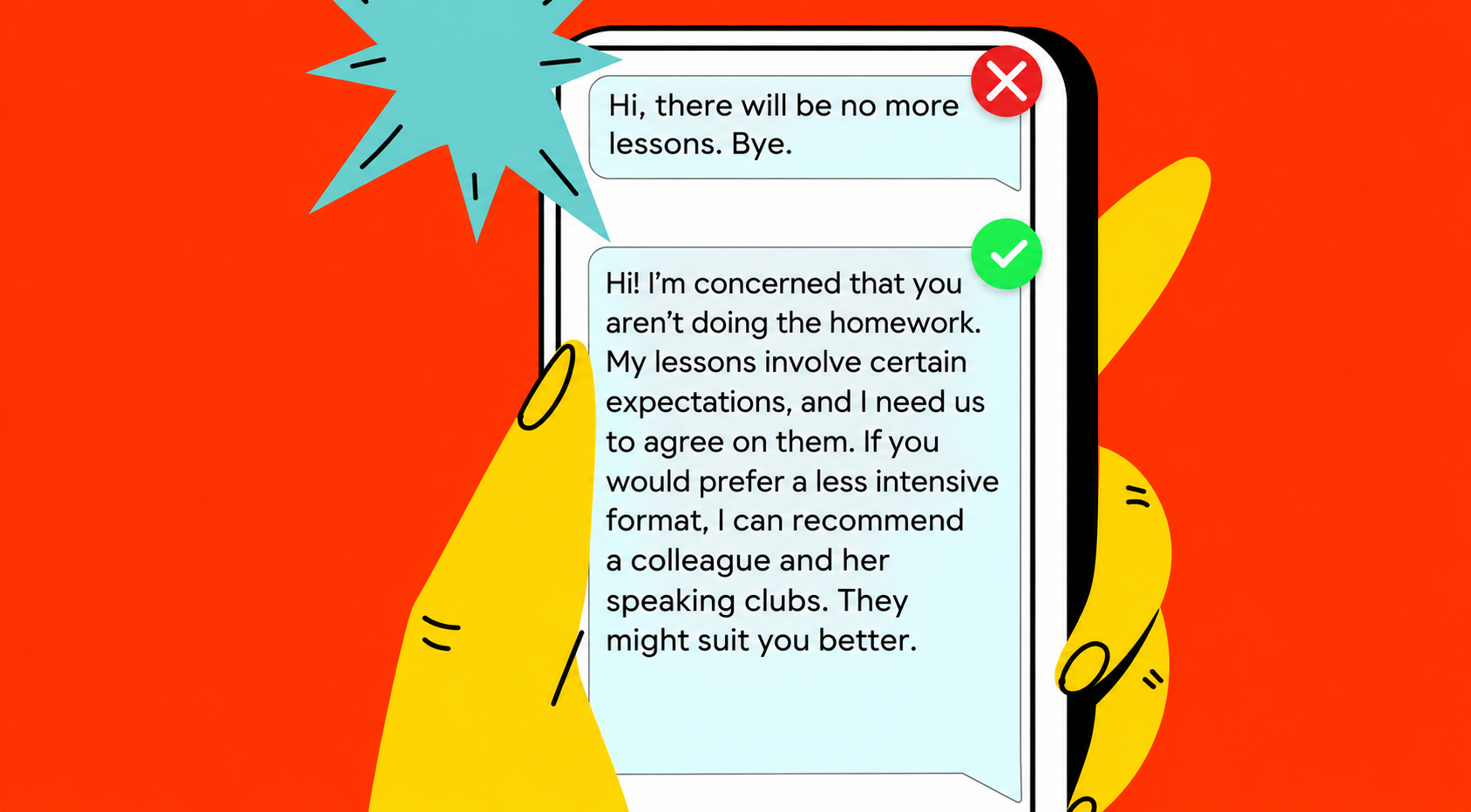
If you are uncomfortable working with a learner for some reason, it can be better to stop rather than make things difficult for both of you. I know that sounds simple, but saying it in practice is hard. Anastasia Lagutkina
Teachers discussing the subject in professional forums share similar experiences. There is no single script for every situation, but a few principles can make the conversation clearer.
1. Try to address the problem first
Depending on the problem, talk to the learner or parents, suggest a different time or format, or discuss support with homework.
Even if those attempts do not resolve things, ending the lessons will then follow a conversation the learner already knows about, rather than come as a surprise.
If the issue is behaviour or unfinished homework, I tell the child’s parents about it beforehand and write to them. By the time I reach the point of stopping, it is not out of the blue for them, one teacher explained in a forum discussion.
2. Be honest
I am strongly against making up excuses. Believe me, that hurts people more than a straightforward refusal, wrote one participant in a teachers’ forum.
An honest explanation of why the arrangement is not working gives both sides a clearer basis for deciding what happens next.
You do not have to justify yourself endlessly. You can say that your workload has changed and you have reconsidered your priorities, or explain that your approaches to learning do not match. I usually suggest other teachers so the learner has a way to continue. Anastasia Lagutkina
3. Prepare for the conversation
First, be clear with yourself about the reasons. Write them down and say them aloud. That can help you explain the decision calmly when you speak to the learner.
What feedback is and how to ask for it
4. Do not simply disappear
Stopping communication without explanation leaves the learner in the same position as a teacher whose student vanishes just before a lesson.
It can also lead to complaints or negative reviews. A direct conversation gives you a chance to explain what is happening and agree on a sensible handover.
5. Set your own boundaries
Write down what you can accommodate and what makes a working relationship unsustainable. When a problem arises, that record can help you make a considered decision.
Whatever the reason, you can choose the learners and timetable you work with. You do not need to feel guilty because you cannot or do not want to help everyone. The important thing is to say it tactfully. Dinara Kasimova, English teacher


