
How to Review Vocabulary with Learners: Tatyana Suslova’s Approach

A teacher with 15 years of experience shares the techniques she uses for reviewing and recycling language.
Tatyana Suslova is an English teacher and author of a Telegram channel for teachers. She specialises in materials for reviewing vocabulary. Here she explains when and how she revisits what learners have studied.
Tatyana includes review in every lesson, but that does not mean repeating the whole lesson. She uses short tasks, such as gap-fills and matching meanings, alongside small routines that can fit into almost any activity.
“I might ask a learner to recall five phrases or words from previous lessons that they want to remember. Their task is to use those five phrases during the lesson wherever they fit naturally.”
At the end, she makes time to reflect.
“We discuss what worked and what did not. If there were phrases they did not manage to use, I ask them to think about where those phrases could have fitted.”
She also uses this approach to bring familiar vocabulary to mind before a task.
“Before speaking, you can give learners time to jot down useful words and expressions, or brainstorm together. Even if they do not use everything afterwards, they have already recalled some of it. That is active review.”
How often should you run a review lesson?
Tatyana recommends a review lesson at the end of a unit or substantial topic, and after a break.
“I have a review pattern. After unit one, we review unit one. After unit two, we review units one and two. After unit three, we review that unit. After unit four, we review units one to four.”
That might sound like a lot of preparation, but she is not teaching every unit again. The aim is to bring some of the language back into use and show learners that it works in different situations.
“We need to give them a situation in which they can do that.”
In her experience, a consistent routine is worth the preparation.
“Some of my learners do not do homework. Systematic review during lessons helps them bring together what they have learnt and use it in speech.”
A coursebook with vocabulary recycled across units can make preparation easier. Tatyana gives Outcomes and Speakout as examples.
Reviewing after a break
When learners return after summer or another break, Tatyana prefers a relaxed lesson that gets them using English again rather than introducing new material immediately.
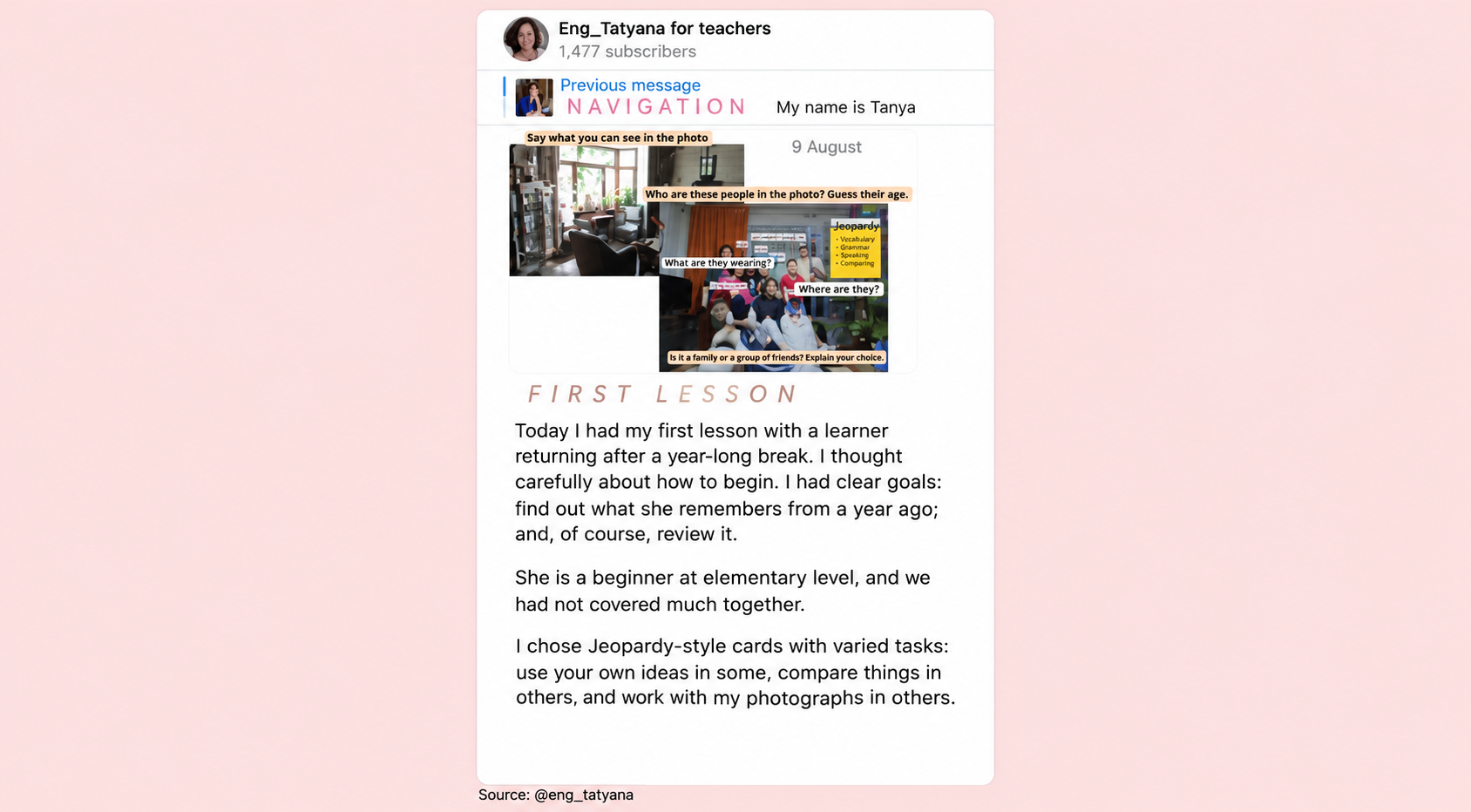
“They have just come back with experiences and stories. Use that. Ask them to bring photographs from their trips. The photographs become something to discuss. Connect them with topics you have covered, perhaps functional language or relevant grammar such as Past Simple and Present Perfect. Talk about a bucket list: what did they do, and what did they not get round to?”
While learners talk, she listens for what they remember and where they need support.
“Note the mistakes and build the next lesson around those points. If Past Simple has really slipped away, prepare some activities to revisit it.”
After that, she returns to smaller review activities until the next unit ends. The larger review lesson comes from the learner’s actual difficulties and the material already covered.
Three formats for review lessons
Here are three formats Tatyana uses.
1. A game
After a unit, try a board game in which each square leads to an activity. Tasks might range from a gap-fill to watching a clip and recognising expressions from earlier lessons. A Jeopardy-style quiz or a lesson quest can work on the same principle.
2. Bring several topics together
Choose one situation that draws on several topics. Suppose learners have studied cities, stereotypes, cultural identity and personality. You could create a role-play about two exchange students arriving in New York. First they meet; then they call their parents and describe their impressions. Each conversation gives them a reason to reuse language from those topics. If you are stuck for a connecting situation, an AI tool can help you generate ideas to assess.
What if learners avoid the target vocabulary and grammar?
“Brainstorm before the task. Help them recall language that might be useful in each situation. Afterwards, discuss what they used and what else might have improved their answers. The process of recalling and reflecting is itself review. Then repeat the task so they can use the feedback and try the language again.”
3. Build a lesson around authentic material
Tatyana often uses film and television clips. They do not have to come from something the learner already knows.
“An intermediate learner and I had covered foreign languages and ways to improve them. I chose a scene from Emily in Paris where the American protagonist goes to a party and tries to talk to people in broken French. We watched it, then answered questions designed to bring back the vocabulary and grammar from that topic.”
Tatyana uses coursebooks too, but finds some review sections feel like separate exercises rather than a connected lesson. A shared topic or situation can make the transitions easier.
Helping learners review independently
She recommends teaching learners how to review, instead of assuming they already know what to do.
“We can trust learners to review independently, but they may not know how. Telling an A2 learner to watch more videos in English does not tell them which ones to choose. Even teachers can find it hard to locate something suitable. Give them a list of resources and links, and explain why returning to vocabulary matters.”
In the interview, she used “at least 20 encounters” as a way of explaining repeated exposure. That is not a fixed threshold that guarantees every word will be remembered.
Her other suggestion is to make learners curious enough to continue on their own.
“You can introduce something interesting in a lesson and stop at a point that makes them want to keep reading or watching. Ask them to find a similar video or meme, or send in vocabulary they encounter. When they do, acknowledge it and encourage them to send more. That helps them notice familiar and new language and practise finding information in English.”
Common mistakes in review lessons
The first, in Tatyana’s view, is leaving review out because you assume homework is enough. The second is doing it inconsistently.
“You forget to review unit one, then try after unit two, and discover that they no longer remember the first unit.”
A third is relying on one kind of task, such as always putting verbs into the correct form.
“Review tasks should involve different kinds of thinking. Sometimes learners sort things; sometimes they invent something; sometimes they invent it and use it. I use a mixture rather than asking them to do the same kind of work every time.”
A fourth is ignoring what learners are interested in.
“Perhaps your teenagers enjoy manga, or an adult learner enjoys Emily in Paris. If you know that but never use it, you miss a chance to interest them enough to watch or read more themselves.”
Finally, do not leave reflection out.
“After an activity, you might discuss only grammar mistakes or the content. But you can also ask what vocabulary from previous lessons could have been useful. That is feedback too.”
Tools for preparing review activities
At the time of the interview, Tatyana used several tools to help prepare or illustrate activities:
- JeopardyLabs
- Baamboozle
- Wordwall
- ChatGPT
- Twee
- Shedevrum
- Leonardo
- Recraft
“There is nothing wrong with gap-fills or matching, but a little creativity can make review more varied. If you often use definitions, ask ChatGPT to write them in the voice of a five-year-old or a businessperson. You could even illustrate the speaker and use an AI animation, if it serves the activity.”
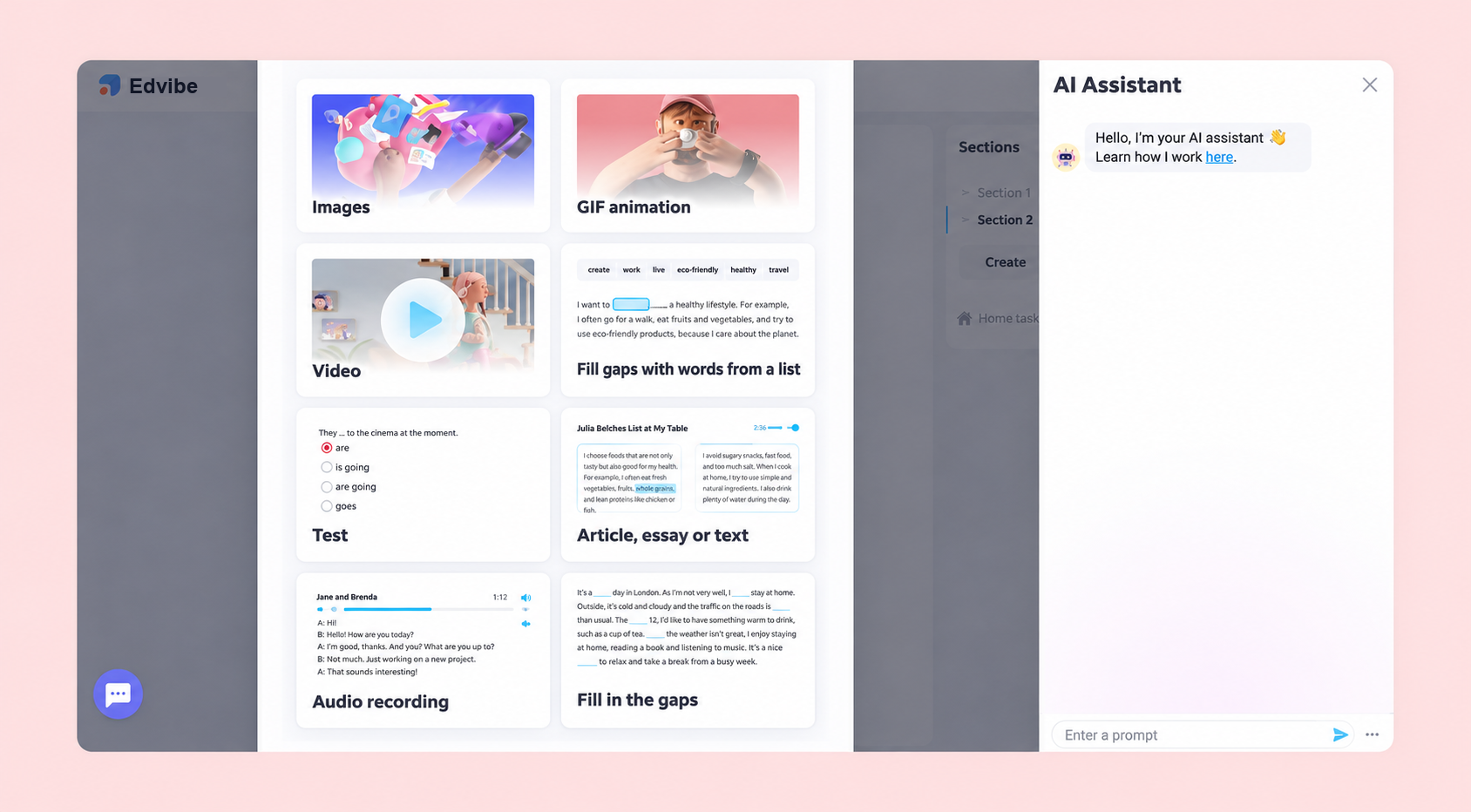
To build a review task in Edvibe, choose an exercise template, such as matching or filling gaps. The AI+ Generate control can draft content from a topic, level and goal. Review the result, edit the examples and check that the task actually recalls language your learners have met.
Want to explore Edvibe? See the current platform and trial options.


